Which Is Right for You: Dental Implants or Dentures in Newark, NJ?
Oct 29, 2026
Dental implants are titanium posts placed in the jawbone that hold fixed replacement teeth, while dentures are removable teeth that rest on the gums. Implants feel more like natural teeth and help preserve the jawbone, but they cost more and take several months to complete. Dentures cost less upfront and are faster to get. Nova Dental in Newark, NJ helps patients compare both before deciding.
Losing one tooth or several changes more than your smile. It can affect how you chew, how clearly you speak, and how confident you feel in conversation. When it’s time to replace missing teeth, implants and dentures are the two options most people weigh, and the right choice depends on your health, your budget, and how you want your new teeth to feel day to day.
A dental implant replaces the root of a missing tooth. A small titanium post is placed in the jawbone, and over several months the bone fuses around it, creating a strong, stable anchor. Once healed, a crown, bridge, or full set of teeth is attached on top.
Because implants are anchored in bone, they don’t shift, click, or need adhesive. They also send chewing pressure into the jaw the way natural roots do, which helps keep the bone from shrinking over time. The trade-off is that implants require minor surgery, a healing period, and enough healthy bone to hold the post. If a damaged tooth still needs to come out first, a tooth extraction is usually the first step in the plan.
Dentures are custom-made replacement teeth set in a gum-colored base. Full dentures replace an entire upper or lower arch, while partial dentures fill gaps between remaining natural teeth and clip onto them for support.
Dentures don’t require surgery, can usually be made in a matter of weeks, and cost less upfront than implants. They’re a practical option for people who are missing many teeth, have significant bone loss, or have health conditions that make surgery a concern. The downsides are stability and maintenance. Dentures can slip while eating or speaking, and because they don’t stimulate the jawbone, the bone underneath gradually shrinks. That changes the fit over time, so dentures typically need periodic adjustments or relines, and eventually replacement.
Here’s how the two options compare on the factors that matter most:
For a single missing tooth, a bridge is another option to consider alongside an implant. It uses crowns on the neighboring teeth to hold a replacement tooth in the gap.
For people missing most or all of their teeth, there’s an option that combines the strengths of both. Implant-supported dentures attach a full arch of teeth to a small number of implants, often four to six per jaw. The teeth stay securely in place without adhesive, chewing feels much stronger, and the implants help protect the jawbone.
Some versions snap on and off for cleaning, while others are fixed and only removed by the dentist. Either way, they offer far more stability than traditional dentures for a lower cost than replacing every tooth with its own implant. Nova Dental’s permanent teeth replacement options are built around this approach.
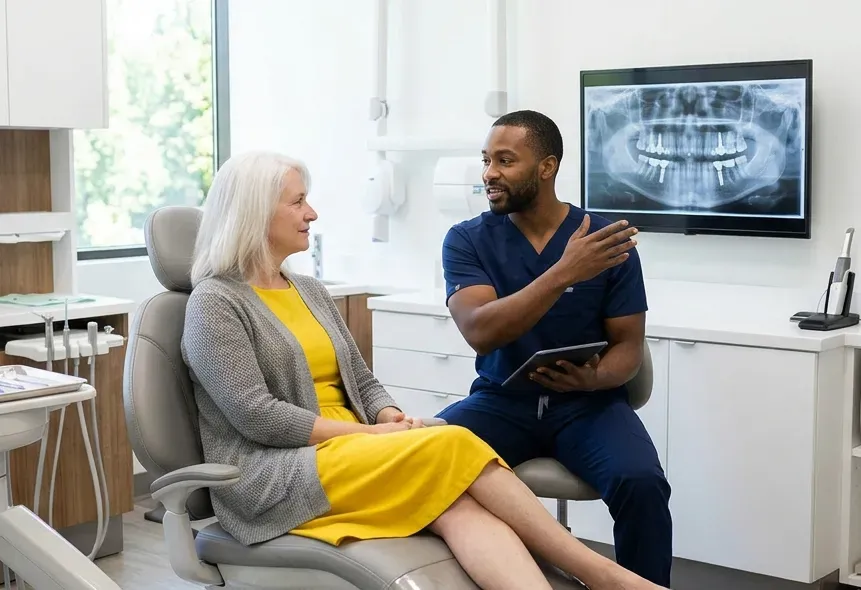
At Nova Dental, the decision starts with an exam and imaging to check your bone, gums, and overall oral health. From there, a few questions usually point toward the right choice. How many teeth are you replacing? Do you have enough jawbone to support implants, or would you need a bone graft first? How do you feel about surgery and a longer timeline? And what matters most to you: lowest upfront cost, or the most natural-feeling result over the long run?
Health factors play a role too. Smoking and poorly controlled diabetes can affect how well implants heal, so your dentist will talk through your medical history before recommending a plan. Cases that need implant placement or bone grafting are handled as oral surgery, with time set aside to answer your questions first.
The sooner a gap is addressed, the more options you’ll usually have. After a tooth is lost, the bone in that area starts to shrink, which can make implants harder to place later. Neighboring teeth can also drift into the empty space and affect your bite.
If you’re living with missing teeth or a denture that no longer fits well, searching for a “dentist near me” and booking an evaluation is the simplest way to learn which options are still open to you.
The right choice comes from an honest look at your mouth, your health, and your goals. Schedule a consultation or call us at 973-604-1600, and we’ll walk you through implants, dentures, and the options in between. Patients from Bloomfield, North Newark, and Belleville visit our Bloomfield Avenue office to plan their next smile.
1. Which lasts longer, implants or dentures?
Implants generally last longer. The post can last for decades with good care, while dentures usually need to be remade every several years as the jaw changes shape.
2. Are dental implants more comfortable than dentures?
For most people, yes. Implants are fixed in place and feel similar to natural teeth, while dentures can rub or shift, especially early on.
3. Can I switch from dentures to implants later?
Often, yes. Many denture wearers move to implants or implant-supported dentures later, though a bone graft may be needed if the jaw has shrunk.
4. Is getting an implant painful?
The area is numbed during placement, so most people feel pressure rather than pain. Mild soreness for a few days afterward is common and manageable.
5. Do implants or dentures cost more?
Dentures cost less upfront. Implants cost more at the start but may cost less over time, since they need fewer replacements and adjustments.