When Do You Need a Root Canal? | Nova Dental Newark, NJ
Sep 29, 2026
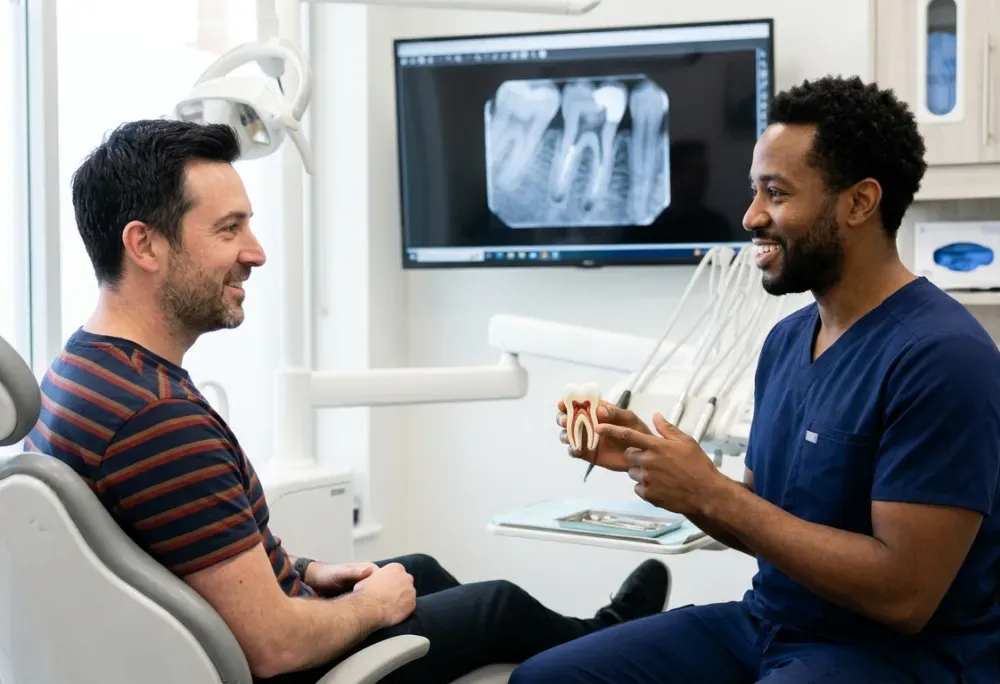
The most common signs you may need a root canal are tooth pain that lingers after hot or cold, sharp pain when you bite down, a swollen or tender gum near one tooth, a pimple-like bump on the gum, and a tooth that’s turning darker. These usually mean the soft tissue inside the tooth is inflamed or infected. Nova Dental in Newark, NJ can confirm the cause with an exam and X-rays.
Most people who search this question already have a tooth that’s bothering them, and many are hoping the answer is “probably not.” That’s understandable, since root canals have a reputation they no longer deserve. The more useful way to think about it is this: the signs below are your tooth asking for help while it can still be saved. The longer an infected tooth waits, the fewer options it leaves you.
Under the enamel and the hard layer beneath it, every tooth has a soft core called the pulp, which holds nerves and blood vessels. When deep decay, a crack, or repeated dental work lets bacteria reach that pulp, it becomes inflamed and eventually infected. Even a hard knock to the mouth can damage the pulp without leaving a visible chip.
The reassuring part is that a fully grown tooth doesn’t need its pulp to survive. As the American Association of Endodontists explains, the surrounding tissues keep nourishing the tooth once the pulp is removed. That’s what makes a root canal possible: it removes the damaged tissue and keeps the tooth itself.
None of these signs guarantees you need a root canal, but each one deserves an exam:
1. Sensitivity that lingers. A quick zing from ice water that fades in a second or two is usually minor. Pain that hangs on for 30 seconds or more after the cold or heat is gone points toward an irritated nerve.
2. Pain when you bite or release. Sharp pain when chewing, especially on one spot, can mean a crack or infection reaching the root.
3. Throbbing that starts on its own. Pain that wakes you up or builds without any trigger is a classic sign of pulp inflammation.
4. A swollen, tender gum. Puffiness or soreness around one tooth often means infection is spreading from the root.
5. A pimple-like bump on the gum. This small bump can drain pus and leave a bad taste. It’s the body’s way of venting an abscess.
6. A tooth turning darker. Gray or brown discoloration on a single tooth can mean the pulp inside is dying.
7. Pain that suddenly stops. This one fools a lot of people. When an infected nerve dies, the pain can disappear while the infection keeps going.
If several of these sound familiar, root canal treatment may be how the tooth gets saved.
Timing matters, so here’s a rough guide to how soon to act:
| What You Notice | What It May Mean | How Soon to Act |
| Brief cold sensitivity that fades within seconds | Exposed tooth surface or mild wear | Mention it at your next visit |
| Hot or cold pain that lingers | Inflamed pulp | Book within a few days |
| Throbbing pain, especially at night | Pulp inflammation getting worse | Call this week, sooner if worsening |
| Gum swelling or a bump on the gum | Infection at the root | Call the same day |
| Facial swelling that spreads, fever, or trouble swallowing | Infection moving beyond the tooth | Go to the emergency room |
If you’ve typed “dentist near me” into your phone at 2 a.m. because the throbbing won’t stop, that alone tells you this is one of the dental emergencies that shouldn’t wait for a routine appointment.
Plenty of tooth pain has simpler causes. A shallow cavity that hasn’t reached the nerve can usually be fixed with a tooth-colored filling. Gum irritation, grinding at night, and even sinus pressure on the upper back teeth can all mimic a nerve problem.
That’s why the diagnosis matters more than the symptom. A proper exam usually includes X-rays to look at the root and surrounding bone, a cold test to see how the nerve responds, and gentle tapping to find which tooth is actually involved. The tooth that hurts isn’t always the one causing the pain.
At Nova Dental, a root canal starts with numbing the area thoroughly, so the procedure feels much like getting a filling. The infected pulp is removed, and the inside of the tooth is cleaned, disinfected, and sealed. Most treatments are finished in one or two visits, depending on the tooth and how far the infection has spread.
Back teeth usually need a crown afterward, since a treated molar is more brittle and takes heavy chewing force. Front teeth can sometimes be restored with a filling instead. Some soreness for a few days afterward is normal, and most people return to work or school the same day.
An infected tooth rarely improves on its own, and catching it early gives you the best chance of keeping it. Schedule a consultation or call us at 973-755-3500. Our Downtown Newark office is an easy trip from Newark Penn Station and the Ironbound, so getting a painful tooth checked doesn’t have to wait.
1. Can a tooth that needs a root canal heal on its own?
No. Once the pulp is infected, it can’t repair itself. Antibiotics may calm swelling for a while, but they don’t remove the infection inside the tooth.
2. Does a root canal hurt?
The procedure itself shouldn’t, because the tooth is fully numbed. Most people say the toothache before treatment was far worse than the visit.
3. Is it better to just pull the tooth?
Usually not. Keeping your natural tooth preserves your bite and avoids the cost of replacing it with an implant or bridge later.
4. How long does a tooth last after a root canal?
With a proper crown or filling and good daily care, a treated tooth can last for many years, often a lifetime.
5. What if my pain went away on its own?
Get it checked anyway. Pain that disappears suddenly can mean the nerve has died while the infection continues.